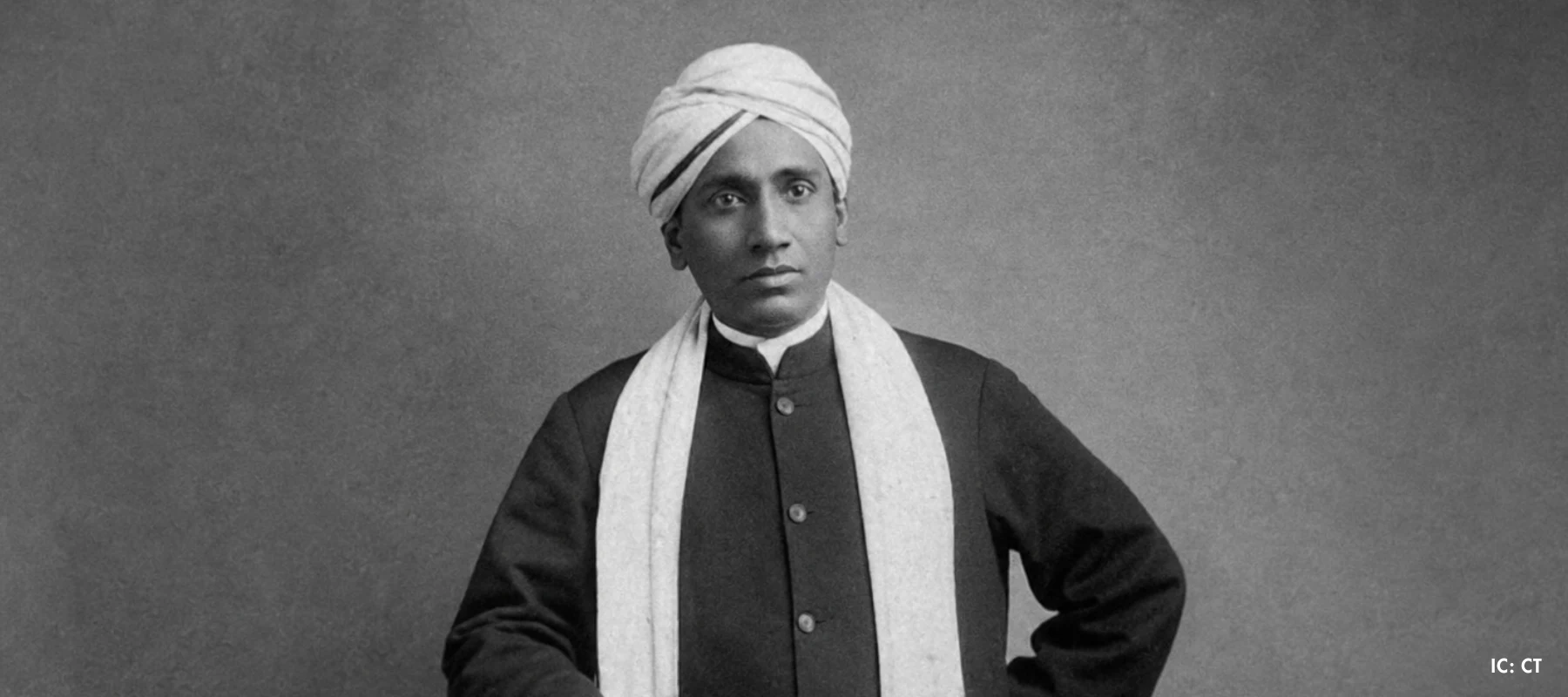
In 1921, on a voyage to Europe, C.V. Raman looked out at the Mediterranean Sea and found himself unconvinced by the accepted explanation for why it was blue. That curiosity, characteristically precise and relentless, would lead him seven years later to one of the most significant discoveries in modern physics.
Born in Tiruchirapalli in 1888, Raman was a prodigy by any measure, completing his university education in his mid-teens and publishing his first research paper at eighteen. He spent years conducting independent research alongside a government job in Calcutta before academia caught up with him and offered the recognition his work deserved.
In 1928, working with his student K.S. Krishnan, Raman discovered that when light passes through a transparent material, some of it scatters at a different wavelength. The Raman Effect, as it came to be known, opened entirely new possibilities in molecular science and remains foundational to spectroscopy today.
In 1930, he became the first Asian to receive the Nobel Prize in Physics. India honoured him with the Bharat Ratna in 1954. He continued working until the very end, at the research institute in Bangalore he had built and named after himself.